

Health Sciences & Homeland Security
Please enable IFrames to use Google Search<!-- <a href="http://www.google.com/search?as_sitesearch=www.swic.edu" title="Click to search swic.edu" >or click here</a>-->.
A-Z 
Blackboard 
Facebook_and_Twitter_Logo 
email_envelope_icon 
Division Links
Phlebotomy

2011 PhlebotomyPhlebotomy at a Glance

  • Starting salary: $24,000
  • Level of patient contact: Moderate
  • Length of Program: Two semesters
  • Program Location: Belleville Campus
  • Program starts: Fall and Spring semesters
  • Gain practical experience at local hospitals


More Information

After reviewing the information found on this page, students interested in the Phlebotomy program should contact Program Coordinator Jean Deitz.


 Job DescriptionBack to Top


Phlebotomists: 

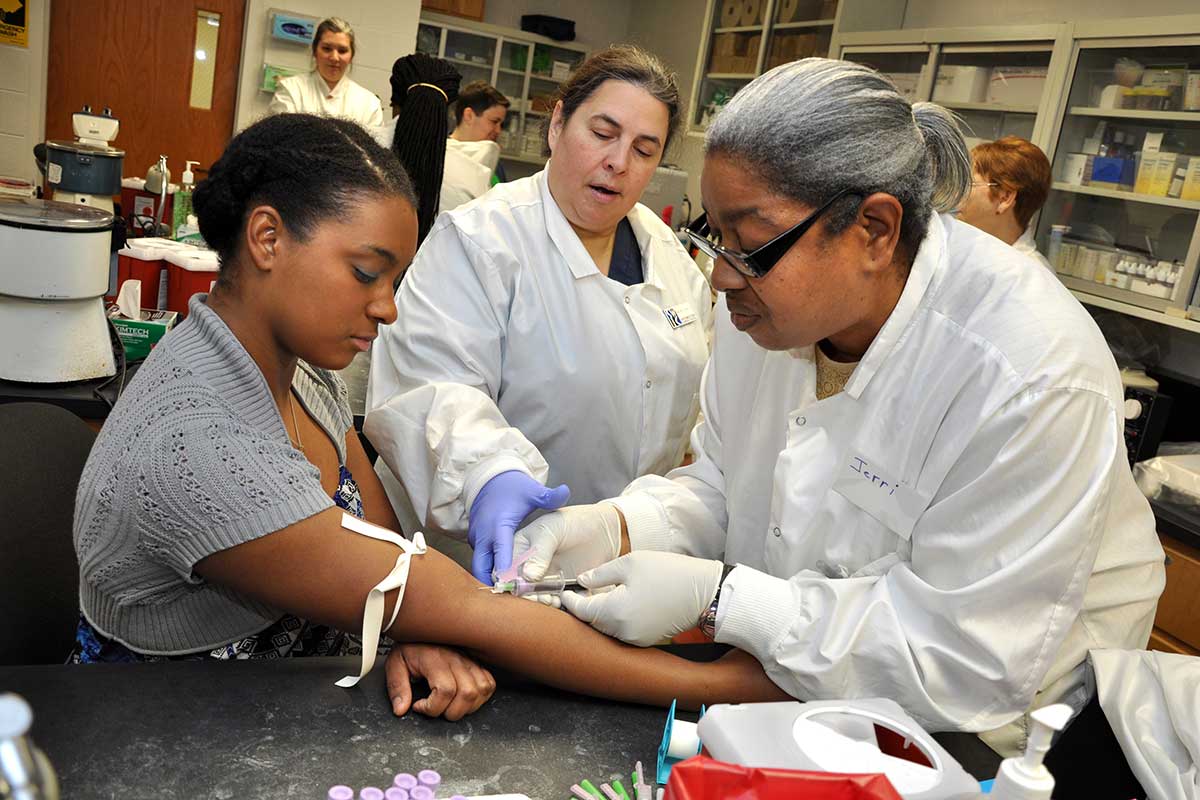
  • Collect and transport blood and other specimens 
  • Effectively explain methods of specimen collection to patients
  • Monitor quality assurance in collection of blood specimens

Performance Essentials

To successfully complete the program and practice as a phlebotomist, students must be able to perform the essential functions of phlebotomy with or without reasonable accommodations. Students are encouraged to meet with the Disability & Access Center to discuss potential issues associated with meeting these requirements.

Career Resources

Visit the SWIC Career Activities and Employment Center for information on career exploration and mentoring.

The American Society for Clinical Pathology website provides career and licensure information.

The U.S. Department of Labor Occupational Outlook Handbook provides additional information regarding phlebotomy.


 Career OpportunitiesBack to Top


Phlebotomists are employed in a variety of settings including:

  • Physicians' offices
  • Hospital settings
  • Clinics
  • Independent laboratories

Career Outlook

Employment of clinical laboratory workers is expected to grow by 14 percent between 2008 and 2018, faster than the average for all occupations. The volume of laboratory tests continues to increase with both population growth and the development of new types of tests.

Frequently, employers desire a year of experience in addition to this phlebotomy certificate.


 SalaryBack to Top


Starting Salary

The average starting salary is about $24,000 plus benefits, but varies depending on the type and location of health care facility.

Increased Salary

Greater income is generally earned when working on the second or third shifts. 


 Enrollment RequirementsBack to Top


The Southwestern Illinois College Phlebotomy program is open to anyone who is a high school graduate or has earned a high school equivalency certificate.

Students must complete the following requirements before beginning program courses:  

1.  Complete the New Student Information Form

The New Student Information Form can be completed in person at a SWIC campus or online on eSTORM.

2.  Complete the COMPASS placement test

The COMPASS placement test assesses skills in reading, writing and mathematics. COMPASS results must qualify the student to enroll in ENG 101 or greater and MATH 94 or greater. 

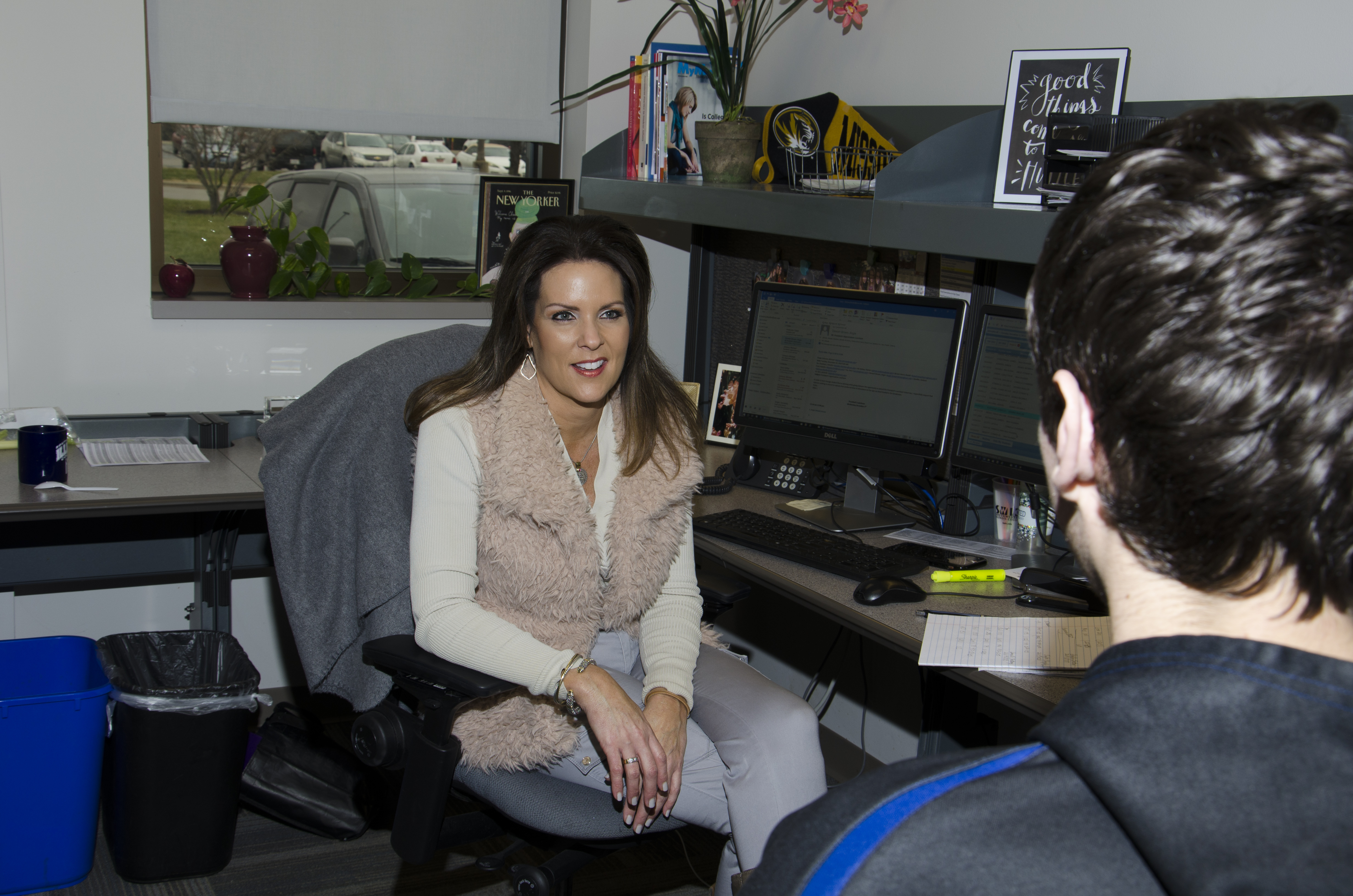
To arrange a meeting with a counselor or obtain more information on the COMPASS program, call or visit a SWIC Counseling Center.


 Course SequenceBack to Top


The Southwestern Illinois College Phlebotomy certificate program provides training in phlebotomy, which is the practice of drawing blood from a person's veins for therapeutic or diagnostic measures.

Phlebotomy Certificate

Phlebotomy Certificate (021B) Course Sequence 

This is a seven-credit-hour certificate program which can be completed in two semesters.

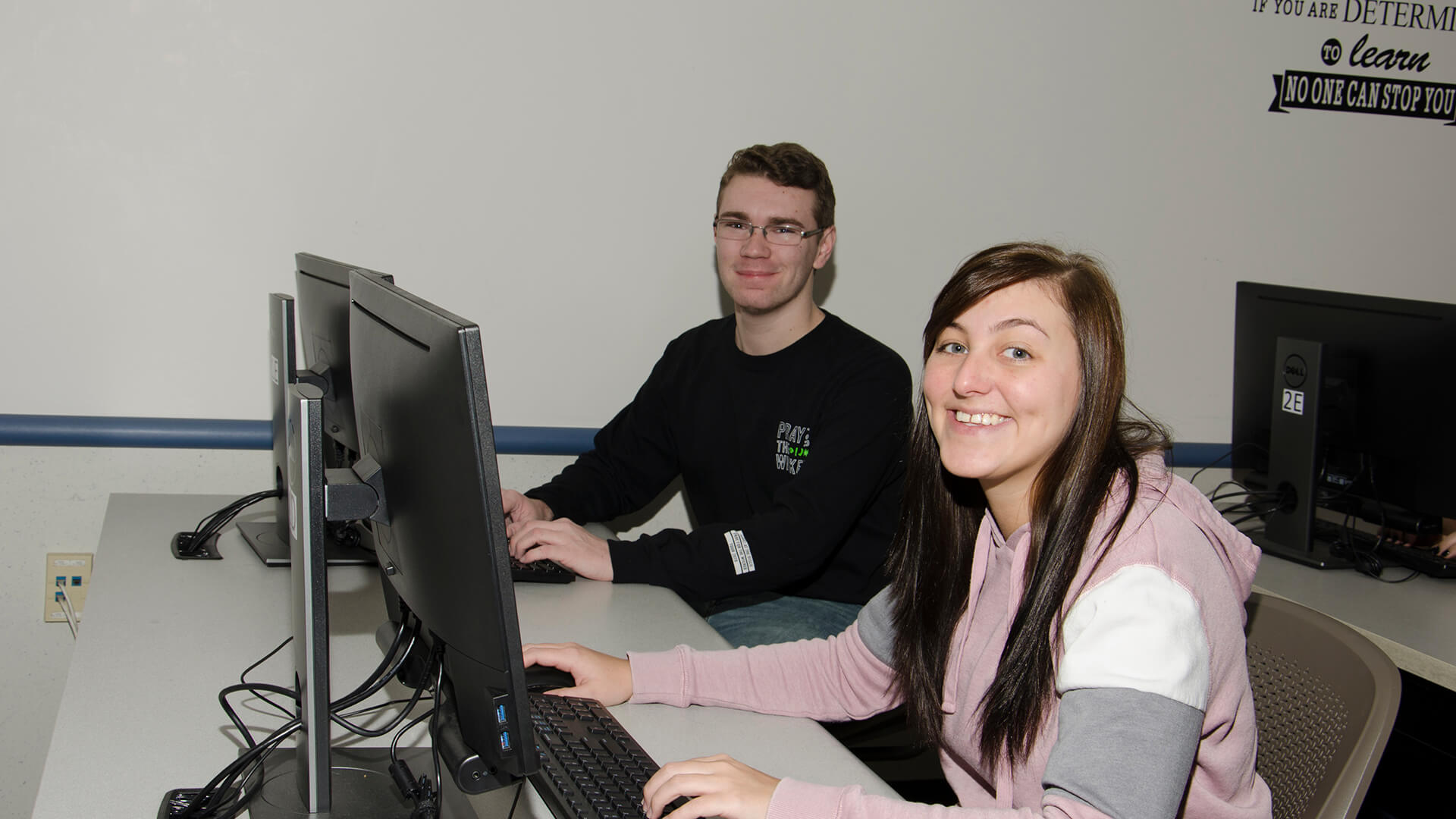
The phlebotomy curriculum includes basic phlebotomy procedures, medical terminology and the use of computers or Windows software programs, followed by 120 hours of supervised clinical experience. 

General Education Courses 

HRO 100 and CIS 120/CIS 125 can be completed prior to the start of the program. These courses can be taken at the Belleville, Sam Wolf Granite City or Red Bud campuses. If general education courses are not completed prior to the start of the program, they must be completed during the first semester.

Phlebotomy Courses 

During the first semester, MLT 100: Introduction to Phlebotomy Procedures can be taken at the Belleville campus.

Clinical Education Experiences 

MLT 242 is offered at area hospitals and clinical facilities during the second semester of the program. Students may be required to travel outside the college district and must have background checks and drug testing prior to starting clinical experience. Specific clinical placement cannot be guaranteed.

Prior to enrolling in phlebotomy clinical course MLT 242, students must have completed HRO 100, MLT 100, CIS 120/CIS 125 with a grade of "C" or better. 


 Program CapacityBack to Top


Belleville Campus

The Phlebotomy program generally accepts 10 students at the Belleville campus each fall and spring semester.


 Program LocationBack to Top


The Phlebotomy program consists of general education courses, MLT pre-fix courses and assigned clinical education experiences. Specific locations depend on the course type.

General Education Courses 

HRO 100 and CIS 120/125 courses are offered at the Belleville, Sam Wolf Granite City and Red Bud campuses.

Phlebotomy Courses 

MLT 100: Introduction to Phlebotomy Procedures is offered at the Belleville campus.

Clinical Education Experiences 

MLT 242 is offered at area hospitals and clinical facilities during the second semester of the program. Students may be required to travel outside the college district and must have background checks and drug testing prior to starting clinical experience. Specific clinical placement cannot be guaranteed.


 Program CostBack to Top


Phlebotomy Certificate program

For details, see the Phlebotomy Certificate cost sheet.

Financial assistance is available!

SWIC Foundation Office   

The SWIC Foundation office offers over 200 scholarships based on residency, enrollment and GPA criteria.

Selsius Corporate and Career Training 

Workforce Investment Act Funding may be available to qualified students. For more information, call 618-235-2700, ext. 5205.


 Time CommitmentBack to Top


First Semester 

The MLT 100 course, Introduction to Phlebotomy Procedures, generally meets two days per week. Classes are eight weeks in length and consist of two hours of lecture and six hours of lab each week.

The general education courses HRO 100 and CIS 120/CIS 125 are generally offered at all campuses at a variety of times. The schedule of general education courses is determined by the student.

Second Semester 

The Phlebotomy clinical occurs in the second semester of the program and requires 120 hours of supervised experience in Phlebotomy. Hours are normally completed during the day, but occasional evening hours are available. Clinicals are scheduled Monday through Friday. Student placement in clinical facilities is dependent on availability of the clinical facilities. Students whose schedules allow completion of the full 120 hours in a three-week period will have priority for clinical placement. No student can complete less than 24 hours per week for clinical practicum.


 Additional RequirementsBack to Top


The following criteria are required of students enrolled in the Phlebotomy program: 

Auto and Health Insurance:

Students enrolling in all Health Sciences programs should be aware that some clinical facilities may require auto and/or health insurance.  Malpractice insurance, when required, is provided by the college through the assessment of lab fees.

Medical Requirements:

Students qualifying for enrollment are recommended to have the Hepatitis B shot series, updated immunization record, current tuberculosis test and a flu shot prior to Phlebotomy clinicals during the second semester of the program. Specific requirements vary depending on the clinical site.

Background Check:

View background check and drug testing requirements. View a list of disqualifying convictions from the Illinois Department of Public Health.


 Work RequirementsBack to Top


ASCP Board of Certification Exam

Upon successful completion of the Phlebotomy curriculum, graduates are awarded a certificate in Phlebotomy and are eligible to take a registry examination from the American Society for Clinical Pathology

Employment Requirements

Some states require phlebotomists to be licensed or registered in order to work.


ContactsBack to Top

For more information about the Phlebotomy program, please contact: 

Program Coordinator
Jean Deitz
618-235-2700, ext. 5386
Jean.Deitz@swic.edu
 

Coordinators' Assistant
Candice Rodgers
618-235-2700, ext. 5355
Candice.Rodgers@swic.edu 
 

Enrollment Services
Admissions Evaluators
618-235-2700
ext. 5541 or 5542
 

SWIC Counseling Center
618-235-2700, ext. 5206
 

Home

RESOURCES FOR: